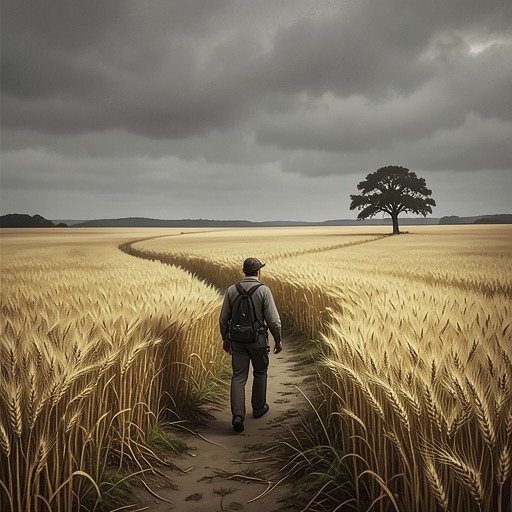
Nature and the cycles of life
The PeasantsNature and the cycles of life form an active presence in the novel rather than a passive backdrop to human affairs. Wind, rain, animals, crops, and the changing fields register death and renewal in their own terms; at the same time, Antek Boryna’s return to his family’s land makes the natural cycle a pattern of inheritance and renewed labor.
Nature at Maciej Boryna’s Death
As Maciej Boryna lies dead, the world outside the room seems to take notice. The wind rattles the orchard and open house, while trees and hollyhocks lean toward the window. A bee enters, a butterfly flies at the candle, a swallow blunders in, and flies, beetles, and other small creatures gather. Their movement is rendered as a collective lament, giving the death a scale beyond the household: the natural world appears to answer the loss rather than merely surround it.
That response changes abruptly with the dawn. The wind drops, living things fall still, and a great red sun rises before disappearing behind shaggy clouds. The stillness and the sun’s brief appearance make a pause between death and the weather that follows. In less than a Hail Mary, fine, warm rain begins to fall over the fields and orchards. The sequence places a single human death beside an encompassing natural passage: mourning gives way to rain, and the rain begins to restore what has been parched.
The rain’s effects are concrete. The day grows colder; birds sing, and thirsty crops, drooping leaves, trees, dried streams, and parched earth drink their fill. The scene describes the land as receiving water with something like gratitude, and its blessing of rain gives weather a social and almost familial presence. Yet renewal is not a denial of death: the rain falls as the household must prepare for Maciej Boryna’s wake, while Hanka Borynowa is already up, sending Pietrek to heap the clover before it softens and ordering Witek to bring out the cows. Grief and work continue within the same living cycle.
The Flourishing Fields and Communal Life
At the indulgence feast, the natural world appears in a different register: not as witness to a death, but as abundance that draws people into motion. Crowds arrive along dusty roads in clattering carts, with horses neighing and voices carrying between travelers. Some pray as they look at the earth, dressed in flowers and greenery, alive with birdsong, rustling wheat, and bees. The festive landscape is not detached scenery; it shapes the gathering’s sense of occasion and helps make the journey feel at once communal and sacred.
The description extends across the fields in particular detail. Trees stand along the baulks; green fields ripple like a stormy sea, and flower-lined lanes and ditches cut through them. Larkspur, bindweed, cornflowers, vetch, buttercups, dandelions, teasel, charlock, clover, daisies, and wild chamomile make the ground visibly varied and abundant. The profusion connects agricultural land with a life that exceeds cultivation: flowers bloom in the crops and thickets, and some are described as known only to the Lord. The fields are both familiar working ground and a source of wonder, so that the community’s religious celebration is inseparable from its perception of the living landscape.
Antek’s Return to the Land
A more inward encounter with nature comes when Antek sits still among the land after his return. Crows come from the forest and peck along the ruts; he throws a clod at them, refusing to become their food. Then other creatures approach without his noticing: ants crawl over his shoulders, butterflies alight on his hair, ladybirds search his face, and caterpillars climb his boots. Birds call above him, and a squirrel considers whether to leap onto him. This accumulation of small, specific movements makes his stillness a point of contact between a human body and the surrounding life.
Antek’s experience expands from observation into a sense of participation. He imagines himself moving with the wind over wheat, shining among young grass, flowing as a stream over warm sand, flying with birds, and joining the murmur of fields and woods. The passage does not reduce the landscape to a symbol for his feelings: its growth, movement, and force are what his feelings seem to enter. Through this encounter he recognizes the land as his father’s and grandfathers’ fields, and his joy at being among his own is joined to a decision to stay.
Renewal, Inheritance, and Labor
Antek’s return makes the cycle of nature inseparable from the cycle of generations. He prepares to take up the heavy work already carried by his father, grandfathers, and great-grandfathers, with Pietruś to carry it after him. The land’s renewal is therefore not effortless or purely seasonal: it depends on people accepting labor and passing responsibility onward. The sequence joins a personal reversal—Antek’s return and resolve to remain—to a longer continuity in which fields are worked across generations.
Taken together, the scenes resist treating nature as decoration for human emotion. Creatures gather around Maciej Boryna’s corpse, rain answers a landscape’s thirst, flowering fields give the indulgence gathering its setting and force, and the forest-edge animals surround Antek as he recognizes his belonging. These distinct moments link mortality, communal celebration, and renewed commitment without making them identical. Life continues through weather, plants, animals, and work; human beings belong to that continuity, but neither grief nor labor disappears within it.